We teach practical, innovative, lifelong learning skills for everyone to reduce stress, increase resilience and promote adaptability. Turn life’s challenges into personal growth.
Charity no: 1107527 | Registered no: 04756998

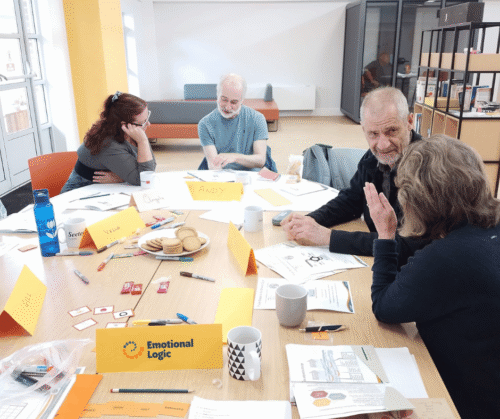
As an HR or People & Culture leader, you are balancing employee wellbeing, performance, and culture under tight resources and rising expectations. Emotional Logic offers a practical, evidence-based conversational method that helps your people process emotions, strengthen relationships, and navigate change more resiliently.
This article explores three powerful ways Emotional Logic can support your people strategy: staff well-being, coaching, and conflict resolution.
HR leaders are expected to deliver on wellbeing, retention, and productivity, often with limited budgets and capacity. The Chartered Institute of Personnel and Development (CIPD) recommends a whole-person approach:
“Organisations should take a holistic approach and provide good work for people that helps to prevent ill health. We define ‘good work’ as work that is fairly rewarded, providing people with the means to securely make a living; it gives opportunities to develop skills and a career, and ideally provides a sense of fulfilment. Organisations also need to focus on the wider dimensions of wellbeing, including financial wellbeing, which still needs more attention given the ongoing cost-of-living crisis. (CIPD, 2023)”
Emotional Logic can play a significant role in your wellbeing strategy by providing:
• Practical tools and language that enhance psychological safety and open, respectful dialogue
• Skills for employees to recognise and respond constructively to their own emotional states
• A framework for teams and managers to process stress before it escalates into burnout, conflict, or absence
While many interventions focus on coping with stress or “managing” emotions, the Emotional Logic method offers a way to recover inner resources by working through emotional responses and restoring relationships. Our 2020 research showed that many who learn Emotional Logic still practise it years later and share those skills with others (Turton et al., 2020), extending the impact of your initial investment.
Traditional staff wellbeing approaches often view employees primarily within the workplace. Emotional Logic, influenced by Systemic Constellations Theory, enables people to identify stressors from a bird’s-eye view across their whole lives. This matters for HR because:
• Employees learn to tackle stressors both inside and outside work.
• The transfer of stress between home and work is reduced.
• You are better able to support sustainable wellbeing, not just short-term symptom management.
Mental ill health is the leading cause of long-term absence in the UK, and managers are often your first line of defence in supporting team wellbeing. Yet only 29% of organisations in the UK offer training to equip their managers for wellbeing conversations (CIPD, 2025).
Many organisations provide mental health awareness training and ask managers to signpost when they suspect mental ill health. While this is important, it under-uses the potential of everyday coaching conversations to build resilience and wellbeing skills before people hit crisis.
Emotional Logic strengthens your coaching and management capability by:
• Giving managers a safe, structured way to talk about emotions without becoming therapists
• Equipping them to notice early warning signs of stress and disengagement and respond constructively
• Helping employees frame emotional responses as useful signals rather than weaknesses or failures
The Emotional Logic Centre has trained Emotional Logic coaches and facilitators for over 20 years. Several published studies have shown the effectiveness of Emotional Logic coaching in improving and preventing mental ill health (Turton et al., 2020; Zahra et al., 2016).
People who learn Emotional Logic regularly report that:
• Their own wellbeing improves.
• Their relationships with partners, children, and colleagues become more constructive.
From an HR perspective, this means Emotional Logic coaching supports two of the top three most common causes of stress-related absence, both of which are non-work-related: personal illness/health issues and non-work relationships/family (CIPD, 2025). By strengthening these underlying areas, you indirectly reduce workplace impact and long-term absence.
Workplace conflict is costly in time, morale, and sometimes legal risk. Grievances, breakdowns in communication, and “personality clashes” often mask unspoken emotions and unmet needs.
Some of our coaches have used the Emotional Logic method to:
• Facilitate conflict resolution between individuals and within teams
• Address relational challenges that undermine collaboration and trust
The method’s phased, systemic approach prioritises sense-making and relatedness. It overcomes defensiveness by facilitating a conversation in which all parties feel truly seen and heard. This:
• Improves communication skills
• Reduces blame and escalation
• Creates a space where people can recognise and value one another’s differences, and explore how they complement each other
Managers can also use this approach to uncover underlying and hidden causes when employees raise grievances, enabling HR to:
• Get to the root of issues more quickly
• Design more sustainable resolutions
• Reduce repeated or entrenched conflicts
At the Emotional Logic Centre, we know that Emotional Logic is much more than a mental health tool. We call it a conversational skill. Wherever people gather, emotions are present and act as messengers and guides. Using their energy constructively is what builds well-being, belonging, and a healthy culture.
For HR and People & Culture leaders, Emotional Logic offers:
• A practical way to embed wellbeing into everyday conversations, not just policies
• A scalable approach that builds internal capability rather than relying only on external support
• A method that supports both work-related and non-work-related drivers of absence and underperformance
If you want to learn more about how Emotional Logic can support your people strategy, reduce absence, and strengthen your culture — or if you’d like a free demonstration of the Emotional Logic method — please contact our office or our business lead, Sven Lauch.
CIPD. (2025). Health and wellbeing at work 2025. https://www.cipd.org/globalassets/media/knowledge/knowledge-hub/reports/2025-pdfs/8920-Health-and-wellbeing-report-2025.pdf
CIPD. (2023). Employee health and wellbeing. https://www.cipd.org/uk/views-and-insights/cipd-viewpoint/employee-health-wellbeing/
Turton, A., Langsford, M., Di Lorenzo, D., Zahra, D., Henshelwood, J., & Griffiths, T. (2020). An audit of emotional logic for mental health self-care improving social connection. European Journal of Integrative Medicine, 37, 101167. https://doi.org/10.1016/j.eujim.2020.101167
Zahra, D., Langsford, M., & Griffiths, T. (2016). Emotional logic development profiles – validating the benefits and safety of emotional logic training. International Journal of Psychiatry in Clinical Practice, 20(3), 141–145. https://doi.org/10.1080/13651501.2016.1197270
Written by Sven Lauch

We teach practical, innovative, lifelong learning skills for everyone to reduce stress, increase resilience and promote adaptability. Turn life’s challenges into personal growth.
Charity no: 1107527 | Registered no: 04756998